A Place Name Is Not a Map
A place name is not a map: learn how inherited names can preserve old terrain, languages and boundaries, and how to read them without misreading today’s landscape.
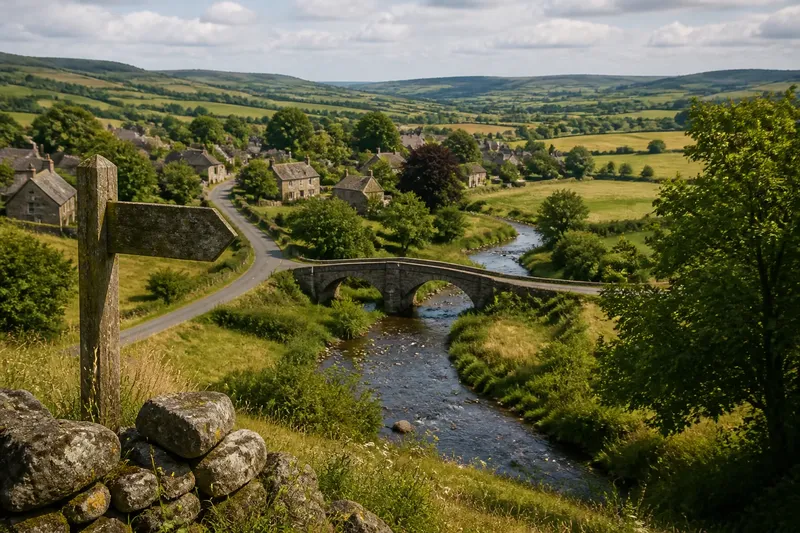
You see “Broadford” on a road sign, but the stream beside the village is narrow and the old crossing is nowhere in sight. A place name is not a map: it may preserve a description of terrain, language or authority that no longer matches what a visitor can see.
That gap is not a mistake to correct. Names travel through speech, records and administration, often surviving changes that erase the original feature. A careful reader treats a name as a clue to a place’s past, then checks what the landscape and local records can actually tell them.
How can a name outlast its meaning?
A name can begin as a practical description. It might refer to a ford, a hill covered in a certain plant, a bend in a river or a settlement near a boundary. Once people use it to identify a place, the name can remain useful even when the feature changes.
A river may shift its course; a crossing may be replaced by a bridge; woodland may be cleared; a wet hollow may be drained. The name continues to point to the same community or locality, rather as a label on an old drawer still identifies where a household keeps its papers after the contents have changed.
Language change can also obscure an original sense. A name may be adapted to the sounds and spelling of a later language, or its elements may become unfamiliar to residents. A modern-looking interpretation can then seem obvious while having little connection to the name’s earlier form.
What can a name tell you about former ground?
Terrain-related names are best treated as prompts for questions, not descriptions of current conditions. A name containing an element associated with a marsh might suggest that wet ground once mattered to people there. It does not establish that the land remains marshy, or even that the element has been interpreted correctly.
Look for features that can be checked independently: the shape of the valley, a surviving stream channel, old field boundaries, historic maps, and records held by a local archive. Maps from different periods may show whether a watercourse moved or a settlement expanded. Place-name dictionaries and local history collections can help explain older spellings, though interpretations may differ.
Compare the name’s location with the wider landscape. A “hill” name might refer to a modest rise that stands out on an otherwise flat plain, rather than a prominent summit. Relative importance to local residents can matter more than the feature’s apparent scale to a visitor.
How can a boundary become hidden inside a name?
Some names preserve evidence of older divisions: a parish edge, an estate, a former administrative district or a meeting point between communities. Later boundary changes may leave the name in use even after the line itself has moved, disappeared or lost its official role.
That does not make the name a precise boundary marker. It may refer to a settlement near a former edge, or to a broad zone where one authority gave way to another. Compare historic maps and boundary records before drawing a line from the wording alone. A name can identify a remembered relationship without showing exactly where a boundary ran.
The same care applies to names that appear to belong to one language or community. The spelling on a sign may reflect official standardisation, while local pronunciation or older written forms preserve other layers. Several versions can coexist without one being a simple error.
How should you investigate a puzzling place name?
Say you are walking through an invented village called Aldercombe. Its name seems to promise alder trees in a narrow valley, but the present road crosses open farmland and no alder grove is visible. You note the stream and the dip in the land, then compare a current map with an older local map and consult a county place-name reference.
Imagine those sources show that the village lies beside an old stream course and that an early spelling differs from the modern name. You could then describe a plausible link between the settlement and its earlier landscape, while leaving open what the name’s elements originally meant. The result is a better-grounded account, not a claim that the visible scene must match the name.
For a first investigation, keep the tasks distinct:
- Record the exact form. Note the spelling on signs and maps, plus any locally used pronunciation.
- Find older spellings. Check historic maps, parish material or archive catalogues for changes in form.
- Identify nearby features. Mark streams, ridges, old crossings and settlement edges without assuming they explain the name.
- Check the name’s elements. Use a reliable place-name reference to assess possible linguistic meanings.
- Compare boundaries over time. Look for former parish, estate or administrative lines if the name suggests a division.
- Separate evidence from interpretation. State what a source records, then distinguish that from your explanation of why the name arose.
For the invented Aldercombe, this process might support a cautious note that the name could relate to an earlier streamside landscape. It would not justify presenting alder trees, a particular valley shape or a precise date of naming as established facts unless the evidence specifically supports them.
Which questions help you read a place name carefully?
Does a terrain name describe the place today?
Not necessarily. It may refer to a feature that has changed, a nearby feature that is easy to overlook, or a meaning altered by language and spelling.
Can a name show where an old boundary ran?
It can suggest that a boundary or jurisdiction once mattered locally, but the name alone rarely fixes the line. Historic maps and administrative records are better evidence for its position.
Why do several explanations appear for one name?
Older forms may be incomplete, and similar sounds can have different roots across languages. Treat competing explanations as proposals to compare against documentary forms and the local setting.
Should the modern spelling be taken literally?
No. Spelling may have been standardised or reshaped to resemble familiar words. Older spellings and local pronunciation can reveal useful clues, though neither automatically settles the name’s origin.
What is the most useful way to use a name?
Use it to begin an enquiry, not to finish one. A name may keep a trace of an earlier river, language or boundary after the visible landscape has changed, but each interpretation needs support from independent evidence.
When describing a place, make the distinction clear: “the name may refer to” is different from “the land is”. That small choice keeps a place name valuable as historical evidence while allowing the present-day landscape to speak for itself.